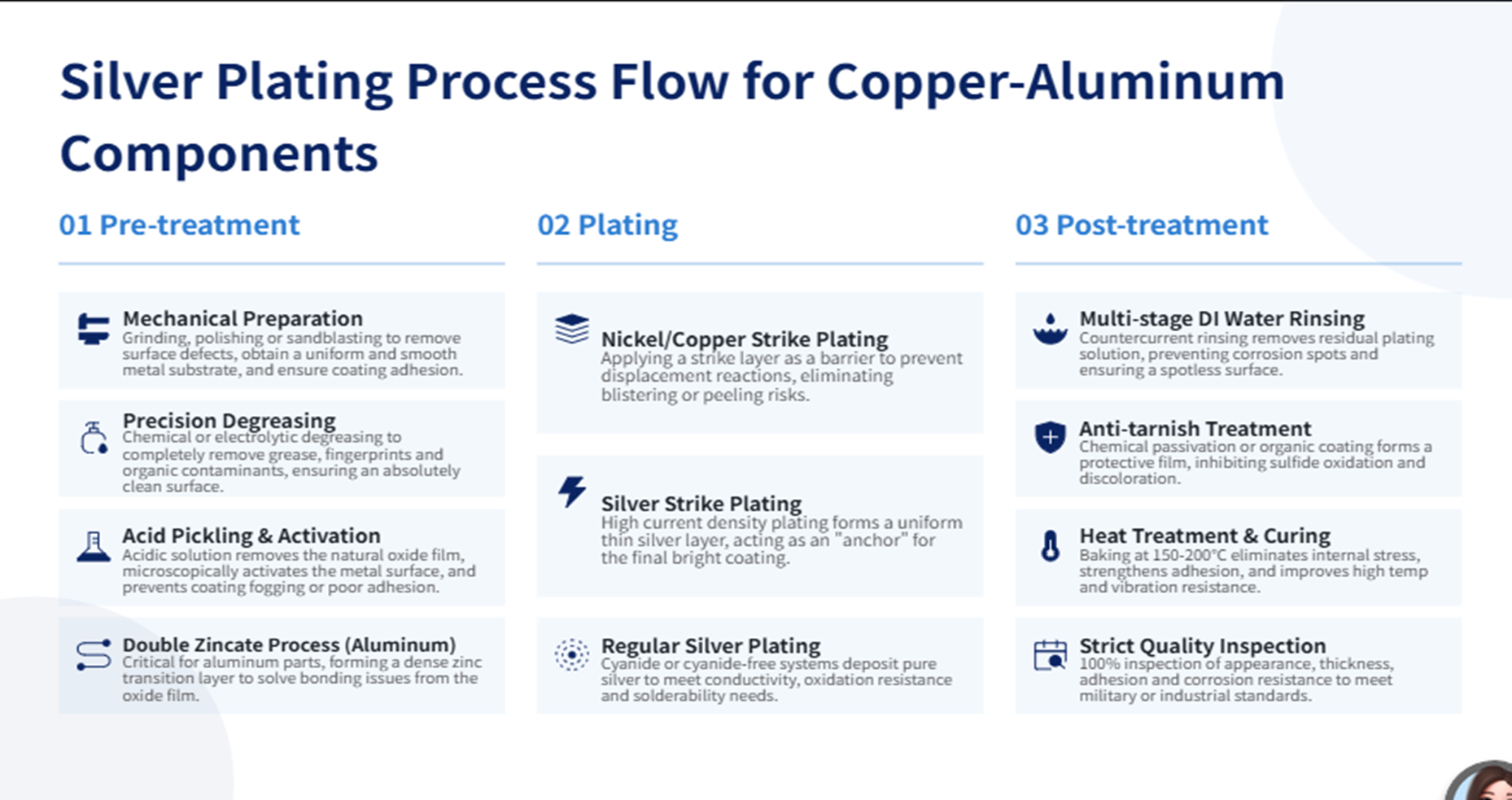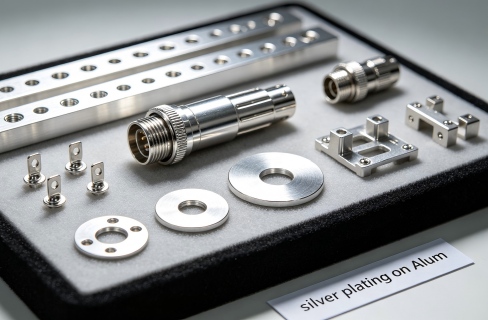
silver plating on Alum
Silver plating services have gained popularity in the lead frame industry as well as in LED applications where silver’s optical reflectivity is utilized. Silver is anti-microbial and has been used in the medical, consumer, and water treatment industries for these natural germicidal properties. Silver plating on aluminum is a process that requires careful preparation and adherence to specific steps to ensure the best results.
Productprocess flowTDSMSDSID:Product Details
process flow
TDS
MSDS
Silver
has extremely high electrical and thermal conductivity –
better than that of gold – which has solidified its use in
high current power transmission and lower current power connector applications.
Silver also is an excellent high temperature lubricant and can be utilized for
various high temperature anti-galling applications within the bearing
or fastener industries.
•Diffusion
barrier: When
silver is plated on copper a natural solid-state diffusion of the copper into
the silver will occur over time. The rate of diffusion is accelerated
greatly at elevated temperatures. As copper diffuses into silver it forms
a hybrid copper/silver eutectic layer which negatively affects adhesion,
solderability and electrical performance. Nickel
forms an effective diffusion barrier to prevent this copper/silver migration
from occurring.
This intermediate layer of nickel is highly recommended in most specifications
and even required in some such as ASTM B700 (Section 6.3.4) and QQ-S-365 (Section 3.3.5).
•Corrosion
Performance: Silver
protects copper from oxidation by
forming a barrier layer between the environment and the copper substrate; this
type of corrosion protection is commonly referred to as barrier corrosion
protection. The addition of a nickel underplate prior to silver plating
helps form a more effective barrier between the copper base and the environment
since it limits the overall deposit porosity. Since nickel is a less
expensive metal than silver, a heavy deposit of nickel can be used to improve
corrosion performance with much less cost impact than increasing the silver
thickness alone.
•Load/Bearing
Durability: The
use of a nickel underplate helps provide a rigid structure for which the silver
layer can be deposited upon. This helps reduce the wear of the silver in
high contact pressure switching and wear applications such as fuse stabs or
high voltage switch gear.
The use of a nickel underplate prior to silver plating copper can improve the performance of the overall deposit in several ways. A few of the benefits of nickel underplate are summarized below: