Nickel Tin on Alum
For aluminum composite components, nickel‑tin alloy plating delivers reliable whisker suppression, stable contact resistance and good solderability, yet strong native aluminium oxide demands strict pre‑treatment. It delivers combined benefits of nickel’s wear‑resistance and tin’s solderability, while suppressing tin‑whisker growth compared with pure tin plating. Plating onto aluminum is challenging because aluminum spontaneously forms a thin, non‑adherent native oxide film; strict pre‑treatment is mandatory to ac...
Productprocess flowTDSMSDSID:Product Details
process flow
TDS
MSDS
Overview
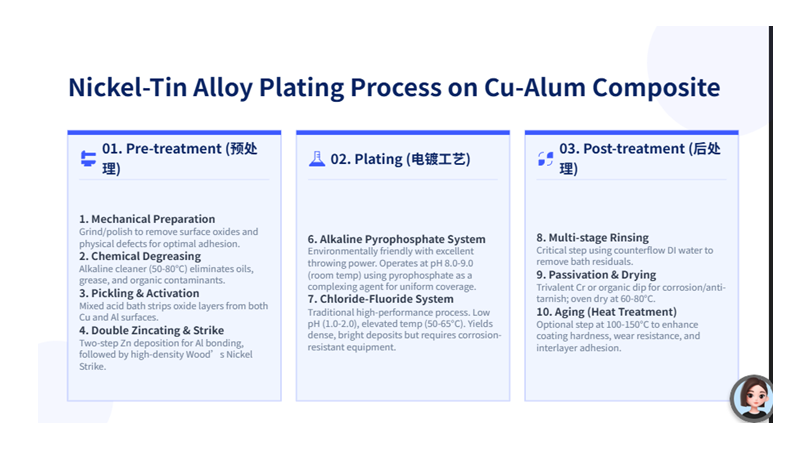
The workflow begins with alkaline
degreasing to eliminate oils and contaminants, followed by mild alkaline
etching and nitric‑based desmutting to
remove oxides and alloy residues. Double‑zincate treatment is critical: an
initial zinc immersion, stripping of coarse deposits, then a second zincate
step forms a fine, uniform intermediate film. A thin nickel strike seals the
zinc layer before nickel‑tin co‑deposition. Bath parameters are tightly
controlled to maintain 20‑40 wt% tin content and target coating
thickness. Low‑temperature
post‑plating baking reduces hydrogen embrittlement risk. Multi‑stage DI‑water
rinsing and hot‑air drying finish the process. Final inspection verifies
appearance, adhesion, thickness and functional performance.
Nickel‑tin alloy plating is an electro‑deposited surface finish widely used for electronic components, connectors and aluminum‑based hardware. It delivers combined benefits of nickel’s wear‑resistance and tin’s solderability, while suppressing tin‑whisker growth compared with pure tin plating. Plating onto aluminum is challenging because aluminum spontaneously forms a thin, non‑adherent native oxide film; strict pre‑treatment is mandatory to achieve reliable coating adhesion.
Typical Pre‑treatment Sequence for Aluminum
-
Alkaline Degreasing: Remove oil, grease and surface contaminants.
-
Alkaline Etch: Micro‑etch aluminum surface; followed by desmutting in nitric‑based acid to flush alloy‑element residues (smut).
-
Zincate immersion (Double‑zincate preferred):Displacement‑form thin uniform zinc interlayer to eliminate native aluminium oxide barrier for subsequent plating; double‑zincate produces finer, more consistent interface for high‑reliability parts.
-
Strike layer: Thin nickel strike to seal zincate layer before Ni‑Sn alloy deposition.
-
Electrodeposit Ni‑Sn alloy: Alloy composition commonly ranges from 20–40 wt% tin; bath types include alkaline‑cyanide‑free and acidic Ni‑Sn electrolytes.
Key Properties of Ni‑Sn Coating on Aluminum
-
✅ Whisker mitigation: Greatly reduces spontaneous tin‑whisker risk vs pure tin plating for high‑density electronic assemblies.
-
✅ Solderability: Good solder joint performance; solderability varies with Sn fraction in alloy deposit.
-
✅ Corrosion performance: Better salt‑spray performance than pure tin; corrosion resistance highly dependent on pre‑treatment quality, coating thickness and alloy ratioPMC.
-
✅ Contact resistance: Stable low contact resistance for connector terminals.
-
⚠️ Limitation: Poor pre‑treatment (residual oxide / smut / incomplete zincate) causes blistering, peeling or spot‑miss plating on aluminum substrates.