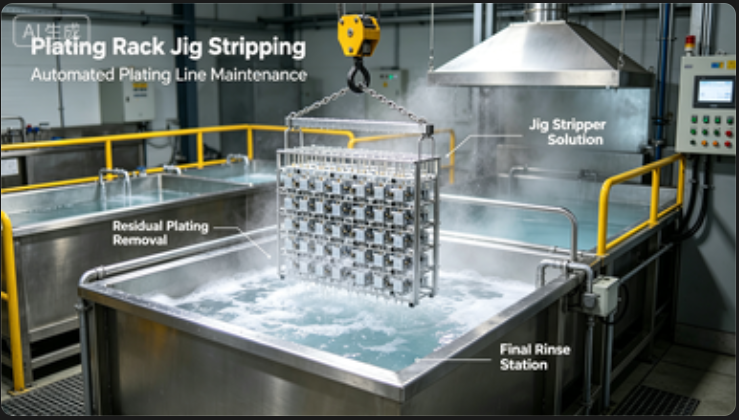
Jig Stripper
Jig strippers (also called rack strippers) are aggressive chemical baths used to remove accumulated metallic plating deposits from plating racks, jigs, fixtures and contact clips. During volume production, metal builds‑up on rack bars, hooks and contact points, increasing electrical resistance, causing particle contamination and poor current distribution
Productprocess flowTDSMSDSID:Product Details
process flow
TDS
MSDS
Jig strippers selectively dissolve unwanted metal coatings while aiming to minimize damage to the underlying rack base material (usually titanium, stainless steel or coated metal). Three major industrial formulation families are widely applied in plating lines.
1. Alkaline‑Cyanide‑Based Jig Stripper
Formulation components
- Sodium / potassium cyanide: powerful complexing agent for copper, nickel, silver, zinc.
- Alkaline hydroxide (NaOH / KOH): raises pH, supports oxidation reaction.
- Oxidizer (sodium hypochlorite or hydrogen peroxide): oxidizes metallic deposits into complexed soluble metal ions.
- Minor wetting agents for surface wetting.
Functions & characteristics Fast stripping speed for Cu, Ni, Ag and Zn. Works well on stainless‑steel racks. Good selectivity for many over‑plated metals. Limitations: Highly toxic; strict fume extraction, personal protection and waste‑water treatment are mandatory. Cyanide waste is heavily regulated. Less common in modern RoHS‑compliant facilities, still used in some legacy plating sites.
Formulation components
- Mineral acid: sulfuric acid or nitric‑sulfuric mixed acid, provides low‑pH working medium.
- Ferric ion (ferric sulfate / ferric nitrate): primary oxidizer to dissolve nickel, copper and tin deposits.
- Corrosion inhibitors: specialized organic inhibitors to slow attack on stainless‑steel or titanium rack substrates.
- Low‑foam wetting surfactants: improve coverage on complex jig geometry.
- Stabilizers: prevent ferric ion precipitation.